
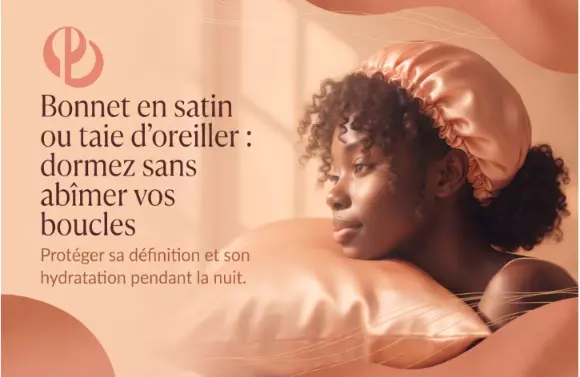
Last night, your curls were impeccable. This morning, the mirror shows a halo of frizz, one flattened side, and strands scattered in three directions.
Do the math: forty-five minutes of routine on Sunday, destroyed by eight hours of sleep. Every night. You spend your mornings fixing things instead of enjoying them, and your curls never last past the first day.
The culprit has been sleeping with you forever: your cotton pillowcase. The solution is cheaper than a leave-in conditioner and works while you sleep. Satin pillowcase, satin pillow, or both? Here's the complete comparison, and most importantly, how to avoid the trap of fake satin that offers absolutely no protection.
Why does hair get frizzy overnight?
Because of friction against the pillow. You change position dozens of times a night, and with each movement, the cotton snags the hair fibers and ruffles the cuticles. It also absorbs some of the moisture from your hair care products. The result: frizz, lost definition, and flat curls.
Protecting your hair at night therefore means neutralizing two well-identified enemies:
- Friction. Cotton is a material that holds. Multiply this micro-snag by hours of movement, and the curl formed the day before unravels fiber by fiber. It's a mechanical process, not an inevitable part of your hair.
- Absorption. A cotton pillowcase acts like a sponge: it soaks up the leave-in conditioner and moisture that your routine had sealed in. Your skincare products nourish the pillow.
Any serious anti-frizz treatment starts with this: eliminating the cause rather than repairing the damage upon waking. And the cause lies in a substance.
Satin bonnet or pillowcase: which to choose?
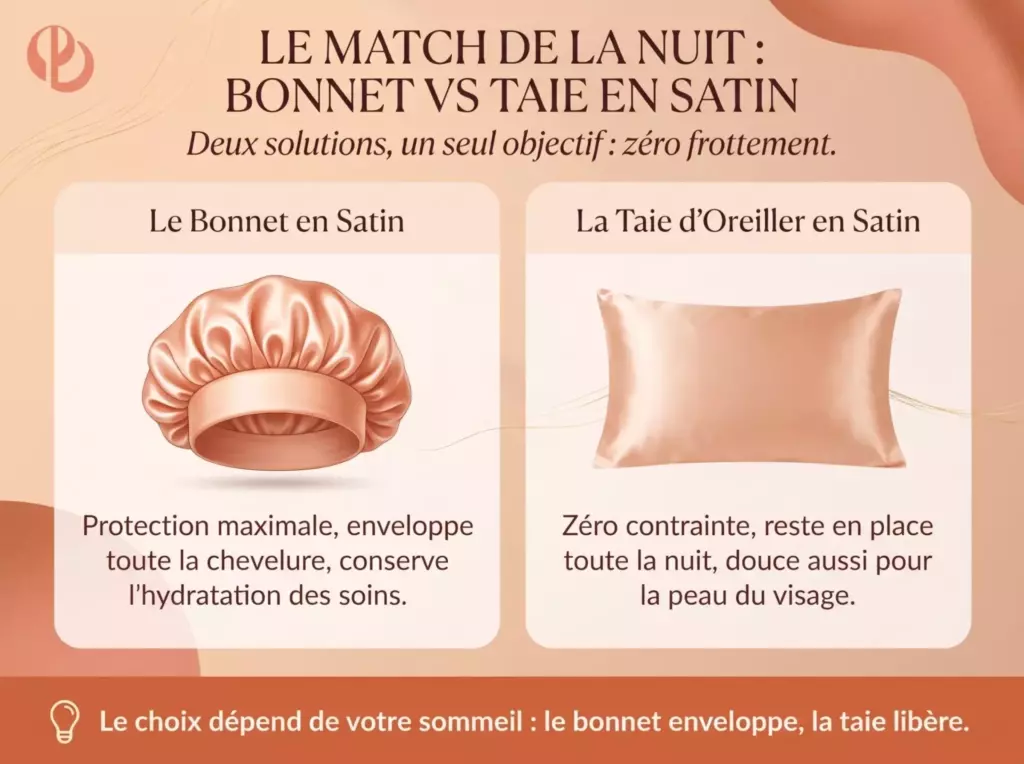
The satin bonnet offers maximum protection: it encases the curls and completely isolates them from the pillow, but it can slip during the night. The satin pillowcase provides protection without being worn, ideal if the bonnet bothers you. Using both together: the solution for perfectionists.
The match at a glance:
| Satin bonnet | Satin pillowcase | |
| Loop protection | Maximum, all-encompassing | Very good, pillow-wise |
| Comfort | Requires an adjustment period | No constraints |
| Lasts all night | May slip or fall | Still in place |
| Bonus | Retains skincare hydration | Also gentle on facial skin |
| On a trip | It fits everywhere | Stay home |
At the salon, our clients consistently tell us that those who are restless sleepers often end up preferring a pillowcase, precisely because their bonnet ends up at the foot of the bed at 3 a.m. If this is you, choose a bonnet with a wide elasticated brim, or gather your curls into a pineapple style underneath: anchored to the high ponytail, it won't budge.
The winning morning duo remains the same in all cases: curls preserved by satin, revived in three minutes with a refreshing spray. Night protects, morning reactivates.
Satin or silk: what's the difference for your hair?
Satin is a weave with a very smooth surface; silk is a natural fiber. A polyester satin bonnet and a silk pillowcase both reduce friction, which is essential for your curls. Silk adds thermoregulation and the prestige of a luxurious material, at a price three to five times higher.
The confusion stems from the vocabulary: «satin» describes the weaving technique, not the material itself. There is, in fact, silk satin, which combines both words and both sales figures.
To choose without making a mistake:
- Is protecting your pillow loops your priority? Classic satin does the job: its smooth surface eliminates pillow friction. Easy care, machine washable, and budget-friendly.
- Are you also looking for the comfort of a natural fiber? Silk breathes better and regulates temperature, a real plus for those who get hot at night. Your hair won't even notice the difference.
Our position is pragmatic: good satin worn every night is better than precious silk reserved for special occasions. Regular use is more protective than the material itself.
How to tell real satin from fake?
First, the feel: on genuine satin, the hand glides effortlessly, the surface is very smooth and shiny, the reverse side distinctly more matte. A faux satin shines but slightly hinders the hand, snags dry skin, and crackles with static electricity. The abnormally low price is the first red flag.
This is the advice our hairdressers repeat most often on this subject: a bonnet sold for three francs on a marketplace is very likely to be a vaguely shiny synthetic fabric, without the true satin weave. It will look like satin in the photo; your curls will feel the difference from the first week, because the benefits disappear with the slip.
What type of satin should you choose, specifically? Check four things before buying:
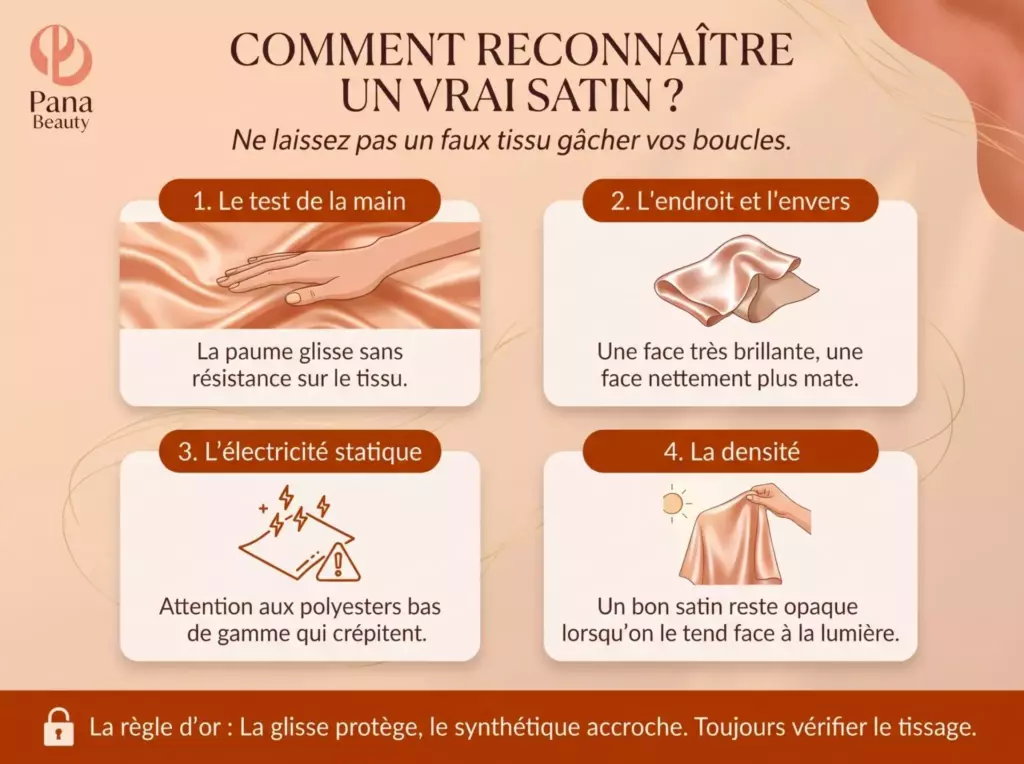
- The hand test. Run your palm flat over the fabric: it should glide smoothly, as if on water. The slightest resistance disqualifies it.
- The contrast between the front and back. The satin weave creates a shiny side and a matte side. A fabric that is identical on both sides is not satin.
- Static electricity. Rub lightly: pronounced crackling sounds betray a very thin, low-grade polyester.
- The density of the fabric. When held up to the light, a good satin remains opaque. It should not be see-through.
If in doubt, go to the salon: touching real satin once is enough to never be fooled again.
Is the satin bonnet suitable for all hair types?
Yes. Wavy, curly, frizzy, kinky, and even straight: all hair types benefit from a friction-free night. The only difference is how you arrange your hair underneath: loose curls for soft textures, pineapple style for medium-length hair, and twists or loose braids for curly to kinky hair.
Instructions for use according to your texture:
- Wavy hair (type 2). Loose curls under the cap, or pillowcase alone if your wave is light: it creases less than a tight curl.
- Curly hair (type 3). Pineapple under the cap: the lengths gathered at the top retain their bounce and the cap stays in place better.
- Curly to kinky hair (type 4). Loose twists or braids before putting on the bonnet: the protection is added to that of the satin, and the hydration from the treatments stays in the fiber instead of going into the pillow.
- Short hair. Just the hat alone, nothing more, without any prior styling.
One universal rule: put the cap on dry hair. Damp hair left in the cap overnight creates excess moisture against the scalp, exactly what we want to avoid.
Satin protects what your routine has built, nothing more, nothing less. If the buildup is lacking, start by our complete method for curly hair A bonnet will never save undefined curls. And to equip yourself with everything at once, including a brush and diffuser, head to our essentials section. the loops routine.
Eight hours of protection, zero effort
In short: nighttime friction and absorption loosen your curls, while satin eliminates both. The cap provides close protection, the pillowcase offers unrestricted protection, and the combination locks everything in place. And the quality of the fabric makes all the difference between true protection and a decorative accessory: trust the feel of the fabric before considering the price.
Your curls work hard all day; give them nights that do them justice. At your next appointment at Pana Beauty, ask to feel the difference between real and faux satin: a thirty-second demonstration, and you'll choose yours with your eyes closed.