

You remember that haircut. You asked for «just the ends». You left with a triangle on your head, curls gone on one side, and six months of regrowth ahead of you.
Since then, the hairdresser's chair fills you with dread. You space out your appointments, split ends appear, and your hair feels heavy. And with each new attempt, it's the same gamble: sometimes it works, often it doesn't. You're not alone: our clients tell us this story almost word for word every week.
The problem was never your hair, or even your hairdresser as a person. It's a matter of training and technique. A successful curly haircut relies on two non-negotiable conditions: scissors trained to work with textured hair, and a dry cut. We'll explain why, and how to choose the cut that will finally showcase your curls.
Why don't all hairdressers know how to cut curly hair?
Because traditional training programs, such as the Swiss Federal Certificate of Competence (CFC) or the French Vocational Certificate (CAP), don't always adequately cover the specific needs of textured hair. Cutting techniques are taught on wet, taut hair, a method designed for straight hair. Cutting curls requires additional training and extensive practice.
It's not a question of talent, but of learned techniques. An excellent hairdresser trained in straightening might, in good faith, apply techniques that don't work on curls: tension on the strand, reference points taken from slicked-back hair, symmetry measured while wet. The result after drying: an unbalanced shape and a client who doesn't recognize what she wanted.
How can you spot a hairdresser who specializes in curly hair before you sit down? Four questions are all it takes:
- «Do you cut dry?» The answer must be yes for curly to frizzy textures, without hesitation.
- «Do you conduct a diagnosis beforehand?» A specialist observes the curl, density, and fall before taking out the scissors, as in our approach to hair diagnosis.
- «Can I see some examples of work done on textured hair?» The portfolio speaks for itself: look for curls, waves, cuts on curly hair, not just blow-dries.
- «What is your training in textured hair?» The pride in the response speaks volumes.
At Pana Beauty, textured hair is not an option on the menu: it is the core of our hairdressers' business, who are specifically trained in these techniques.
Should you cut curly hair when it's dry or wet?
Dry, no question. Wet, the curl is loose: it shows neither its true volume, nor its natural shape, nor its true fall. Cutting wet hair is like cutting blind and discovering the result only when it dries. Dry, the hairdresser sees exactly what they are sculpting.
This is the whole logic of the curly cut: cutting the hair as it is worn, curl by curl, in the direction of the curl.
The reason lies in a word that all curly-haired people know but don't necessarily say: shrinkage. As it dries, a curl springs back, sometimes by several centimeters, and even more so if the curl is tight. Two strands cut to the same length on wet hair can dry to different heights, depending on the springiness of each curl. On dry hair, this pitfall disappears: the density, volume, shape of each curl, and the actual fall are all visible to the hairdresser as they cut.
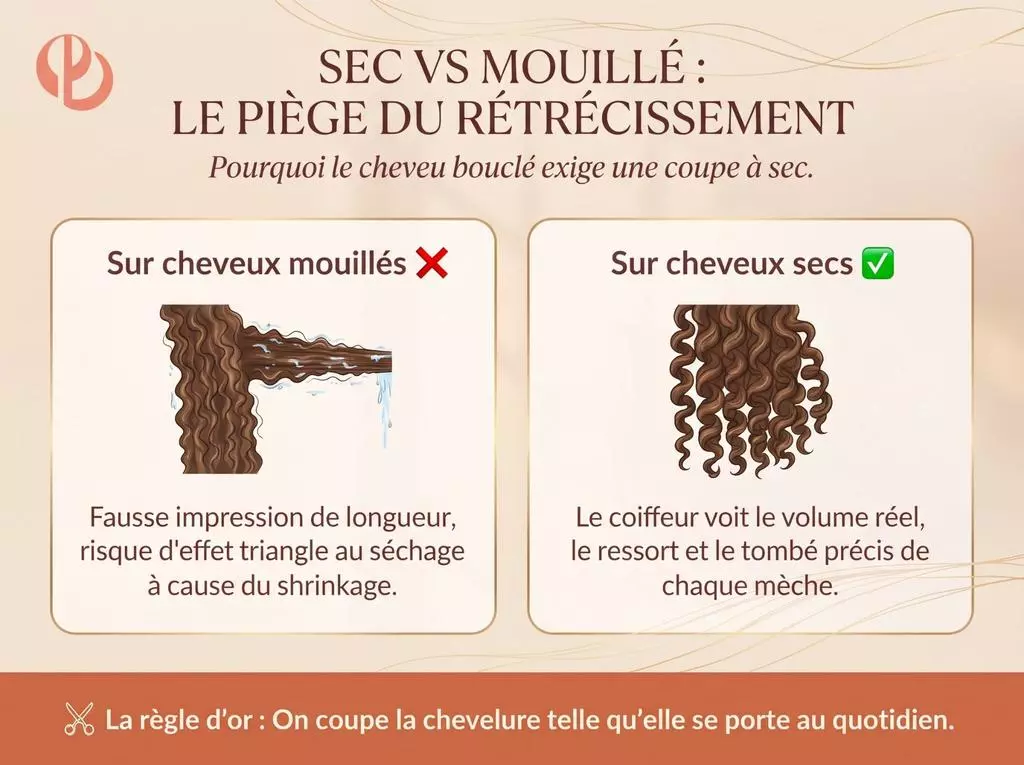
The only caveat: barely wavy, almost straight hair can handle a classic wet cut. As soon as the curl really forms, a dry cut is necessary.
What is the best haircut for curly hair?
The one who thinks about volume in three dimensions. A layered cut adapted to your curl type and face shape remains the safest bet: it distributes the mass, lightens the ends, and avoids the triangular effect. Curly bob, long layers, or a rounded cut: the choice is made with the curls in hand, never based on a photo alone.
The triangular shape deserves an explanation, as it's the hallmark of unsuitable haircuts: cut straight across, at a single length, curly hair concentrates all its volume at the bottom. Flat roots, flared base, a Christmas tree silhouette. Layering breaks up this pyramid by redistributing volume along the entire length.
Forms that work, by family:
- The long gradient. Maintains length while lightening the bulk. Ideal for a first structured cut without sacrificing volume.
- The curly bob. Structured and modern, it adds character to both soft and defined curls. It requires a hairdresser confident in their technique: on curls, a bob doesn't forgive imprecision.
- The round cut. For curly to frizzy haircuts, she sculpts a balanced halo that embraces the volume instead of fighting it.
Your Pinterest photo is still welcome at the salon: it's an excellent starting point for discussion. But the texture of the model isn't yours, and it's the consultation that translates the inspiration into a feasible cut.
What kind of layered cut is best for curly hair?
A gradual gradient that follows the spiral of the curl: neither limited to the ends nor too short on top. Soft curls: a longer gradient for movement without losing volume. Tight curls: a more pronounced gradient that builds the rounded shape. The classic pitfall: layers that are too short at the top, causing them to curl up.
The layered cut of curly hair is adjusted like a musical instrument, using three parameters:
- Your loop type. The tighter the curl, the more pronounced the gradient can be: the springiness compensates for the difference in length. On a slight wave, a pronounced gradient creates visible layers.
- The shrinkage to anticipate. A good hairdresser always cuts lower than the visual target, in anticipation of the hair rising again when completely dry.
- Your tolerance for maintenance. A pronounced gradient needs refreshing every three to four months to maintain its shape; a long gradient can tolerate six months of waiting.
And if your fear is «too short on top», say so from the outset: this is precisely the kind of instruction that a dry cut allows you to respect to the centimeter, with a reference loop to back it up.
How to fix a bad haircut on curly hair?
First, don't cut it while it's still hot. Wait two to three weeks: the curl will settle, the shrinkage will relax, and the initial disaster will often be smoothed out. Then, rebalance it with styling, and finally, entrust the final touches to a specialist who will do a dry touch-up, removing as little as possible.
The rescue plan, step by step:
- Weeks 1 to 3: Time is on your side. The freshly cut curls are finding their place. What seems catastrophic on day 1 is often manageable on day 15.
- Camouflage hairstyling. Thick roots and a well-defined root system with a brush They visually rebalance an unbalanced shape. A pineapple or a scarf can help on difficult days.
- Dry harmonization. The specialist does not «redo» the cut: he harmonizes what exists, loop by loop, sacrificing as little length as possible.
- Accepting patience. Hair grows about one centimeter per month. A solid routine protects every centimeter gained: our A complete routine dedicated to curly hair does the rest.
A special case: if your hair is straight or brittle due to straightening or repeated heat, no amount of cutting will restore the curl.
Haircuts for medium-length curly hair: what are the options?
Mid-length hair is the perfect playground for curls: enough length for the weight to tame the volume, yet light enough to maintain bounce. Three sure bets: a long, curly bob, a layered, airy mid-length cut, and optionally, a curly fringe. Anticipate shrinkage: aim for two to three centimeters shorter than your target length.
In detail:
- The long, curly bob (lob). Between chin and shoulders, structured yet flexible. It frames the face, stays put, and gives a clean look even on days of quick refresh.
- The mid-length layered cut. The most versatile: distributed volume, natural movement, reasonable maintenance. This is the cut we most often recommend as a first approach.
- The curly fringe. It transforms a classic mid-length cut into a signature style. Be honest about maintenance: curly bangs need refreshing every morning with a spray bottle and trimming every six to eight weeks.
The mid-length cut has one final virtue: it's forgiving. Short enough for the shape, long enough to recover, it's the ideal length to get back into the swing of things with scissors after a bad experience.
Two criteria, zero lottery
Remember the key point: a successful curly haircut requires a stylist trained in textured techniques and a dry cut, curl by curl. The rest—shape, layers, length—is decided through discussion, supported by a consultation and an inspirational photo.

If your last haircut was a bad memory, come and turn the page at Pana Beauty: our stylists cut dry, on curls they know inside and out, and the consultation always precedes the scissors. Your curls deserve hands trained just for them.