

Winter is setting in, hair feels tight, and the reflex is almost touchingly logical: pull out all the stops, a comforting oil bath, generous coconut or melted shea, left on for a long time like a grandmother's remedy.
And yet, January tells a different story: split ends, stiff curls, dull lengths. The treatment meant to save the season seems to have made things worse. So, not understanding why, we double the dose, and February gets even worse.
The culprit isn't the oil: it's the thermometer. Below 15°C, heavy oils and butters change texture, solidify on the fiber, and work against it. Here's the mechanism, the gentler approach that takes over throughout the winter, and the schedule for resuming oil baths at the right time.
What is an oil bath and how do you do it?
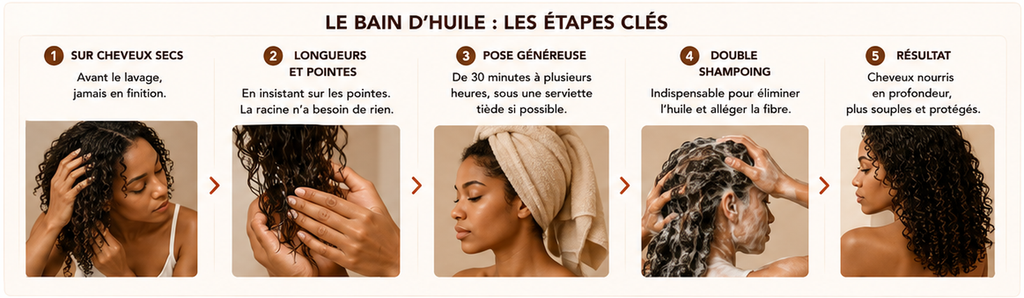
An oil bath is a pre-shampoo treatment: a vegetable oil is generously applied to dry hair, from mid-lengths to ends, left on for thirty minutes to a few hours, then rinsed out with a double shampoo. Its purpose: to deeply nourish the hair fiber and protect it from the stripping effects of the subsequent wash.
The basic technique for capturing the essentials:
- On dry hair, before washing. The pre-shampoo oil bath is a preparation treatment, never a finishing touch: its place in the chain is fixed.
- Lengths and tips only, emphasizing the latter. The root, as always, needs nothing.
- A generous break in time, from half an hour to the entire evening, possibly under a warm towel.
- A real double shampoo afterwards, non-negotiable: residual oil would weigh everything down, and the first pass is precisely for degreasing.
When done correctly and at the right time of year, it's an excellent treatment. The entire point of this article hinges on those last four words: at the right time of year.
Why do oils change texture below 15°C?
Because oils and butters rich in «solid» fatty acids solidify when the temperature drops, just like your jar of coconut oil, liquid in summer, becomes a solid white block in winter. Worn outside in cold weather, the layer of oil deposited on your hair undergoes the same transformation: it hardens on the hair fiber.
The demonstration is right in your kitchen. Coconut oil melts at around 24-25°C: above that, it runs; below, it hardens. Shea butter, even harder, only softens with the warmth of your hands. These changing textures, charming in a jar, become a problem for hair that spends the day between a heated office and a 3°C breeze.
And here's the point that our hairdressers' descriptions sum up in a single image: as the oil solidifies, it takes up more space. The thin, flexible film in the bathroom becomes, outside, a rigid coating that settles between and under the hair fiber's scales, pushing against them. The treatment has transformed into mechanical stress.
Not all oils are created equal: light oils like argan or jojoba remain fluid in the cold. This is precisely what makes them suitable for winter, as we'll discuss later.

Can an oil bath weaken the scales in winter?
Yes, and that's the paradox of the season: heavy, solidified oil pushes the hair cuticles apart instead of smoothing them. Under this stress, the cuticle lifts and weakens: breakage, split ends, curls lose their definition, and lengths become dull. October's hair care routine becomes January's problem.
Let's revisit the chain of damage, as we see it unfold at the showroom every winter:
- The pushed-out scales lift up. A raised cuticle is a vulnerable cuticle: the fiber loses its natural protection and smooth feel.
- The stiffened fiber breaks. Trapped in its coating of solidified oil, the strand loses its suppleness; when brushed, it gives way instead of bending. The ends, already fragile, fall out first.
- The loop loses its definition. Weighed down and rigid, it no longer rebounds: the spring sags, the form unravels.
- The brightness fades. A surface with raised scales reflects light poorly: dull winter hair often has this story, in addition to ambient dehydration.
The signs that an oil treatment has gone wrong in the cold are easy to spot: stiff, crunchy locks as soon as you take them out, a waxy feel that lingers, and curls that remain rigid despite the treatment. If your winter looks like this, then what follows is definitely for you.
What can be used instead of an oil bath when it's cold?
With light and stable textures that coat without weighing down or stiffening: the sublimating oil and treatment serums take over as a finishing touch, while deep nourishment comes from formulated treatments, rich mask and leave-in, where shea and coconut work in a dosed and stabilized version.
Because the need for nutrition does not disappear in winter, it simply changes format:
- The sublimating oil, The official successor: a few drops on dry lengths, it nourishes, protects and adds shine without ever feeling heavy. It's the texture designed to withstand the elements.
- Treatment serums, same family: they coat the fiber and treat the tips, stable in all weather conditions.
- Skincare products formulated with shea butter and coconut, Masks and leave-in conditioners are key: your favorite winter ingredients are carefully measured to protect without stiffening. This is the principle outlined in our article on the 3 ingredients that protect curls in winter.
- The LOC method, winter version, with a light oil in layer O: the layering continues to seal, detailed in the LOC method.
The goal remains unchanged, to hydrate your hair all year round: only the vehicles change with the weather.

When should I resume oil baths?
As soon as temperatures consistently rise above 15°C, spring marks the beginning of the season, with summer and early autumn at its heart. In the depths of winter, the home calls for a break, and for those who cherish the ritual, there's an indoor compromise.
The oil bath calendar, season by season:
- Spring and summer: The season is open. The oils remain fluid, and the ritual delivers its full benefits, especially as a pre-shampoo treatment after swimming, which can be drying. A quick reminder: a double shampoo afterwards is still essential, as dictated by the frequency and rules of washing.
- Early autumn: These last comfortable sessions, as long as the thermometer holds up.
- Heart of winter: Take a break from heavy oils and switch to lighter textures. For those who are committed to their ritual, there's a compromise: a warm oil treatment on a night when you're not going out, using a medium-strength oil, and wash it out completely before heading back outside. The problem has never been oil at home; it's oil that's solidified on the go. Simply monitor your hair's reaction, and at the first sign of stiffness, go back to lighter oils.
A thumbs-up rule for the whole year: if your jar of coconut oil is solid on the shelf, your hair prefers something else this month.
The right care at the right thermometer
Let's recap the seasonal rule: oil baths are an excellent pre-shampoo treatment… above 15°C. Below that, heavy oils harden, push out the cuticles and break down what they were meant to nourish; the replacement shifts to light textures and formulated ingredients, until the return of spring.
The next generation awaits you at Pana Beauty salon: our sublimating oil and treatment serums, stable in all weather conditions and silicone-free, take over from November to March. Your hair doesn't have to choose between being nourished and surviving the winter: it can have both, in the right format.