
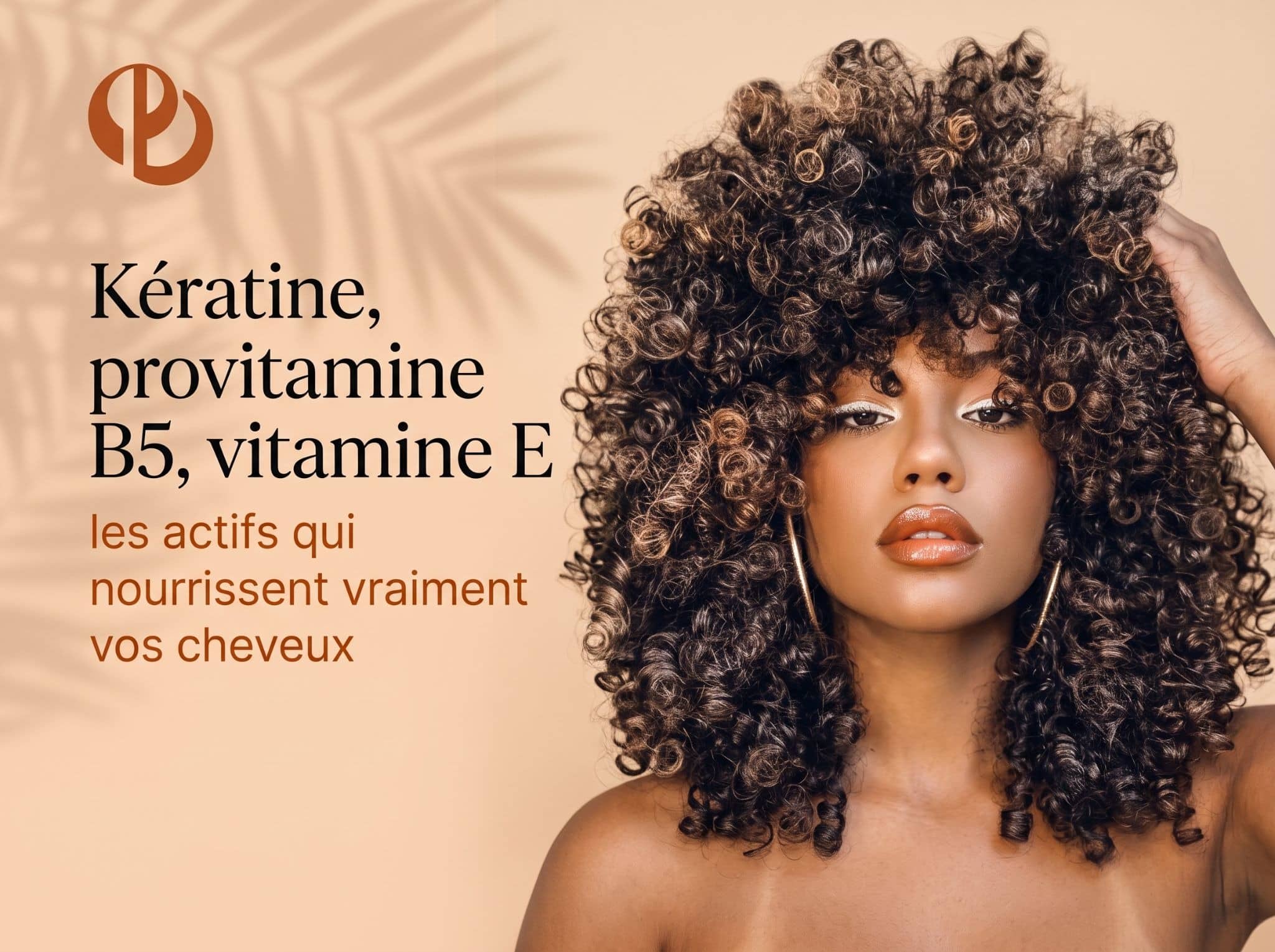
«"With keratin": this label appears on one out of every two bottles. Alongside it, provitamin B5, vitamin E, plant proteins: the hair care aisle speaks a language no one has taught us, and we buy based on the promises.
So we trust it. "Repairing keratin" sounds good for damaged hair. Three months later: stiff, brittle lengths, worse than before. Nobody told you that a miracle ingredient, in excess, becomes a saboteur.
Here's the guide to active ingredients without the marketing hype: what each one actually does in fiber, at what dose it helps, and when it becomes harmful. At its heart, the truth about keratin, this friend that means well… in moderation.
What is the purpose of provitamin B5 (panthenol) in skincare?
Provitamin B5, or panthenol, is a dual-purpose active ingredient: it deeply nourishes the hair fiber and restores its body, while also attracting and retaining water. Both hydrating and strengthening, it's the bridge between the two worlds of skincare, and one of the most versatile ingredients available.
If any product deserved the title of a Swiss Army knife for hair, it would be this one. Provitamin B5 for hair works on two fronts at once:
- In terms of depth, It penetrates the fiber and nourishes it from within: the hair gains substance, this "body" that makes the difference between hair that falls flat and hair that holds its shape.
- Regarding hydration, Its humectant nature attracts water and helps it stay in the fiber: panthenol hydrates while it strengthens.
It's this dual action that makes it so valuable for almost all hair types: tired hair, fine hair lacking body, and thirsty lengths. And that's why you'll rarely find it contraindicated, whereas other active ingredients, keratin in particular, require careful consideration. So let's talk about it.
Keratin: friend or foe?

A friend, provided you use it in moderation. Keratin is the protein that makes up over 90% of your hair: as a treatment, it fills in the gaps in a damaged fiber and restores its strength and structure. But it's a building block, not a daily nutrient: used sparingly, it repairs; in excess, it breaks.
Our hairdressers' advice is always the same: less is more. Understand the true role of keratin in hair and the paradox disappears:
- What she does well. On porous hair fibers, weakened by coloring, heat, or time, the keratin in a treatment fills the gaps, like plaster on a damaged wall. The hair regains density, strength, and bounce.
- What she doesn't do. It doesn't "nourish" in the sense of oils, nor does it hydrate in the sense of water: it structures. Three different needs, three families of active ingredients, and keratin only covers one of them.
- His employment conditions. A wall needs plastering when it has holes, not every week. A healthy or already treated fiber has nothing to fill: the keratin then accumulates on the surface, and that's when the friend changes sides.
Can you use too much keratin?
Yes, and that's the trap of the aisle: excess protein overloads the hair fiber. Imagine an overfed hair, so full that its cuticles eventually burst under the pressure: stiff, rough, it breaks cleanly at the slightest brushing. Protein overload produces exactly the symptoms we wanted to treat.
The image of our hairdressers' hair remains famous in the salon: "obese" hair. From the constant layering of protein treatments—keratin shampoo, keratin mask, keratin serum—the hair fiber stores more protein than it can absorb. This excess hardens, the cuticles lift and then burst, and the hair, paradoxically crammed with its own substance, becomes as brittle as glass.
The signs of excess protein in the hair are easily recognizable:
- A new rigidity : the lengths have lost their suppleness, they "crack" under the fingers.
- A clean break, without stretching: the strand breaks suddenly, a signature of hair that breaks due to overload and not dryness.
- It feels like straw despite the care., which worsens with each new protein treatment, since the remedy is the poison.
The solution: stop all protein treatments for several weeks and switch to pure hydration—moisturizing masks, leave-in conditioners, gentle methods—until suppleness returns. Then, reintroduce proteins gradually, if and only if the hair fibers need them. How do you know when? Next section.

Protein or hydration: what do my hair need?

The elasticity test is decisive: gently stretch a wet strand. If it breaks cleanly and feels rough, it needs hydration and protein. If it stretches limply and doesn't spring back, it lacks structure; a protein treatment will help. If it stretches slightly and springs back, it's balanced; don't add anything.
It's the compass that avoids the two pitfalls: the thirsty fiber that's force-fed protein and the sluggish fiber that's drowned in water. The protein-hydration balance is reflected in behavior:
- The thirsty fiber (sharp breakage, roughness, frizz in humidity) requires sealed water: this is the territory of hydrating your hair before nourishing it (Silo Pillar 3), and keratin has no role to play there for the moment.
- The fiber that lacks structure (soft, excessive stretching, no spring) welcomes a short course of protein treatment: micro-dosed keratin or lighter rice protein, until the return of bounce.
- The balanced fiber Maintains regular hydration, protein in occasional visits.
Why does a personalized treatment make all the difference?
Because no ingredient list can replace understanding your hair fiber: the right treatment adjusts the dosages to your current hair condition—a dose of B5 for the body, a touch of keratin if the fiber is depleted, none if it's saturated, a few drops of zinc if needed. That's the whole logic of customized treatment: the formula adapts to you, never the other way around.
This is where the salon's expertise truly shines, and a behind-the-scenes anecdote illustrates this better than any explanation. One of our clients, Maïte, left with her personalized treatment: the active ingredients perfectly dosed for her hair type, a whipped cream texture she loves to work with, and even the scent—a monoi oil she chose herself—that transforms her Sunday routine into a little escape. The treatment she uses is one of a kind: hers alone.
Custom-made products change three very concrete things:
- The right dosage. No more relying on a standard bottle: keratin is added to the formula if your fiber is lacking it, and it's released as soon as it's replenished. Excess becomes impossible.
- Evolution over time. Your hair changes, seasons, colours, cuts: the formula follows, adjusted at each appointment.
- Pleasure, which creates regularity. A texture we love, a scent we choose: the treatment we want to do is the only one we do every week.
What active ingredients contribute to shine? To the body of the hair?
For shine: vitamin E, which strengthens the hair fiber and revives radiance, supported by argan oil and a light oil finish, all on tightly closed cuticles, because shine is simply light reflected by a smooth surface. For body: provitamin B5 takes center stage, with rice protein providing a light boost.
The memo by objective:
Objective: Shine
- Vitamin E for hair It acts like vitamins in a balanced diet: it strengthens the skin's structure, and strengthened fibers reflect light better. It's the ultimate radiance-boosting ingredient.
- Argan oil, restorative and luminous
- The gestures These are just as important as the active ingredients: a combed mask that closes the scales, a rinse finished with fresh water, and a sublimating oil as a final touch.
Body and outfit objective:
- Provitamin B5, our dual role from the beginning: it provides the substance that makes a hairstyle hold.
- Rice protein, The lightweight cousin of keratin: it adds body without the risk of overloading, ideal for fine hair.
- Micro-dosed keratin, in targeted treatment, when the elasticity test allows it.
One last word about a false friend of shine: silicones, which create a glossy effect by coating the surface without adding anything to the fiber. The shine is real, the health is an illusion, and the film accumulates.
Assets are tools, not promises.
Let's recap the toolbox: B5 for body and hydration, vitamin E for strength and shine, rice protein for lightness, and keratin as an exceptional repairer—never used daily, or you risk "obese" hair that breaks. The elasticity test determines, moderation dictates.
And if you prefer a custom-made formula, that's literally what we do: at Pana Beauty salon, your treatment is created specifically for you after a consultation, including active ingredients, texture, and fragrance. Your hair has a formula just waiting for it; come and discover it.