
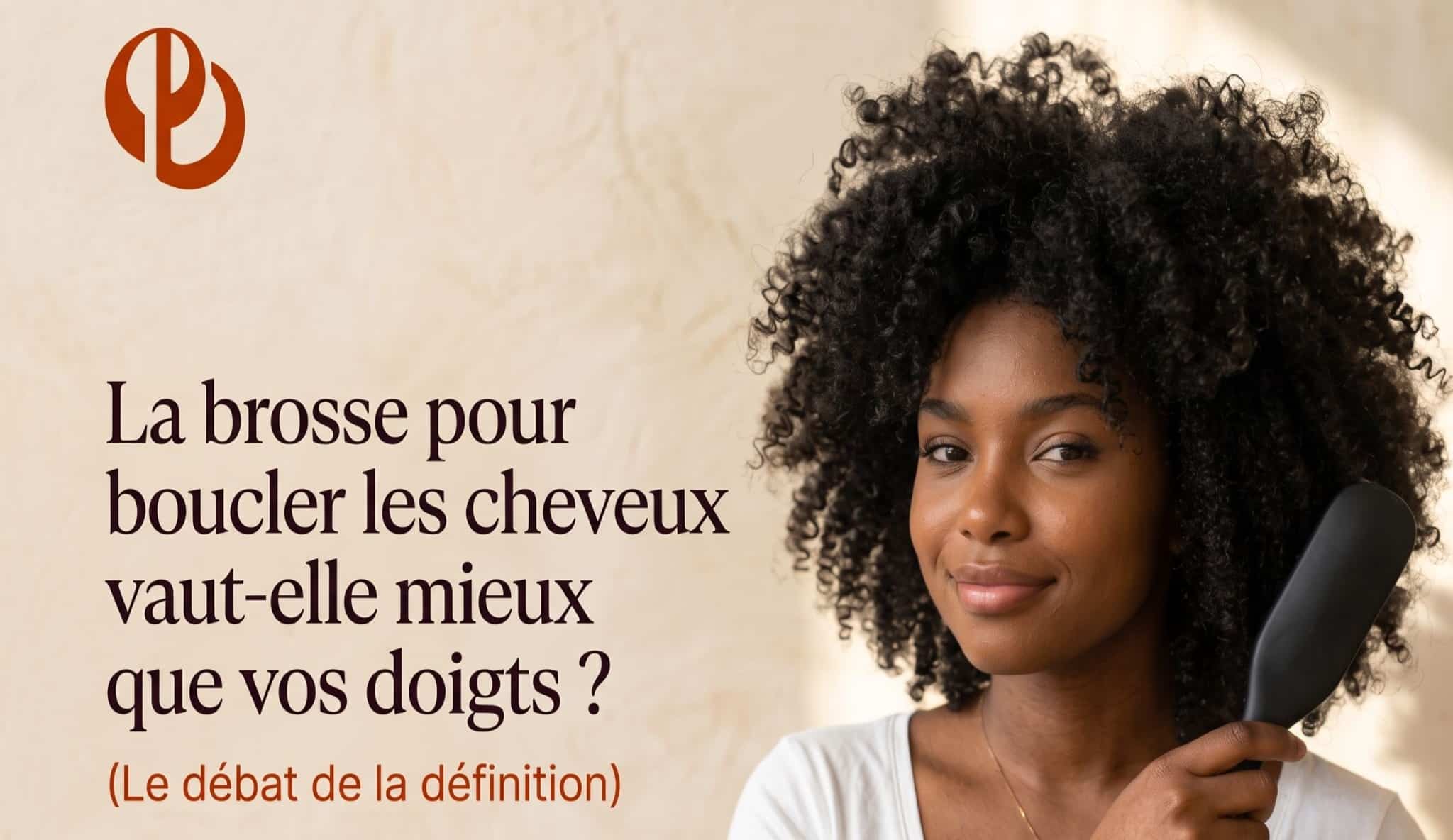
On social media, the gesture seems magical: a brush glides along a strand of hair, a flick of the wrist, and a perfect curl springs up. Three seconds flat.
At home, the same brush produces a messy mess. Or worse, strands that puff up in every direction. You conclude that the technique «doesn't work on your hair,» and the brush ends up in the drawer of disappointed purchases.
She hasn't done anything wrong, though. Both a brush and your fingers work, but not for the same result, and certainly not with the same movements. Here's how to choose your technique depending on the look you want, and the details of execution that separate a clean curl from a cloud of frizz.
Which brush should I use to define my curls?
A defining brush: firm, widely spaced bristles arranged in several rows. It's this rigidity that gathers the strand, stretches it, and gives it the curl's movement. It also distributes leave-in conditioner and gel evenly along the entire length, something no finger can do as well.
The Denman brush popularized the technique within the curly hair community, to the point of lending its name to the technique. Above all, remember what matters in a curling brush, regardless of the label:
- Rigid spikes. Too flexible, they pass through the strand without gathering it. The curl needs real tension to form.
- Spaced rows. They separate the hair into small, regular sections, which will become distinct curls.
- A size adapted to your density. Fine hair: narrow brush for precise strands. Dense hair: wider format to move forward.
Our defining brush was chosen based on these criteria, and our hairdressers use it daily in the salon. One last, and most important, reminder: the brush should be used on wet, product-laden hair, never on dry hair.
Brush or fingers: which technique to choose depending on the desired result?
The brush creates defined curls quickly, with volume: ideal for thick hair and busy mornings. Working each curl individually with your fingers is slower, more precise, but less voluminous. Most of our clients combine both methods on the same head of hair.
The match at a glance:

A single detail in brushing technique can even change the final style: the direction. Brush downwards and you get a wavy effect, almost a curl. Brush upwards and the curl tightens into a spring, with more body. Same brush, two hairstyles.
Our salon tip: test both techniques on two adjacent sections on a relaxed, routine day. Your hair will give you a better cut than any product, including ours.
How to get volume with curly hair?
Brush the strands upwards. Place the brush under a thin section, apply tension towards the ceiling, then release suddenly: the curl forms as it rises, bouncy from the roots. This is the most effective way to add volume without using mousse.
The volume of curly hair is built up during the defining process, not after. In order:
- Make thin separations. Sections that aren't too wide create more curls, resulting in fuller-looking hair. Four large sections create a flat hairstyle.
- Stretch upwards, release. The tension aligns the fiber, the release triggers the spring. The higher the strand is lifted, the more the root remains detached.
- Don't touch it anymore. Each loosened strand is finished. We move on to the next one.
- Dry upside down with a diffuser. The volume gained with the brush sets during drying.
Conversely, if you find your hair too voluminous, keep the brush horizontal or slightly downwards: the curls will lengthen and become more defined.
How to do finger curls around the face?
Isolate a thin strand of hair around your face, damp and saturated with product. Wrap it around your index finger in the direction of its natural curl, hold for two or three seconds, then slide your finger downwards. The strand will retain the springy shape created.
Finger curls are the precision tool for definition. They are reserved for areas where the brush is too wide:
- The fine hairs around the edge, those famous angel hairs that frame the face and are the first to frizz.
- The unruly locks who refuse to join a neighboring loop.
- The parting and the temples, very visible, where a hand-drawn loop provides the finishing touch.
Two mistakes to avoid: wrapping a section of hair that's too thick (the curl will collapse under its weight) and working on dry hair (nothing will hold). If the area has dried out, give it a light mist of spray and start again.
Allow one to two minutes for the entire contour of the face. It's this small step that gives that «just-left-the-salon» finish, even when the rest has been done quickly with a brush.
Why shouldn't you go over a section of hair that's already been cut?
Because ironing destroys what's in the process of setting. Once formed, the curl dries in its coating of product and takes its final shape. One more stroke of a brush or finger breaks this structure: the curl unravels, the hair frizzes, and flyaways appear.
This is the golden rule of any definition, and the number one cause of the disappointing results we see in the salon. The reflex to «just readjust» a strand costs more than it saves.
If a curl is truly ruined, don't fix it: redo it. Re-wet it with a spray bottle, add a touch of gel, and redefine it completely, using a brush or your fingers. Thirty seconds, perfect result.

The same discipline applies during drying: no fingers in your hair until it's completely dry. Then, you can use your hands again to soften the serum's stiffness and restore movement. In fact, defining is only one step out of seven: to ensure each step is in the right place, our complete guide to a curly hair routine explains the entire sequence.
Volume with a brush, precision with a finger: it's up to you to create.
Remember the logic: use a brush for speed and volume, pulling the strands upwards; use your fingers for finishing the contour; and in both cases, a finished strand is a strand you don't touch again. The feel of the movement, the precision of the sections, and discipline do the rest.
The good news: none of this requires any special talent, just a little practice and the right tool. Our defining brush is available in the salon and online, and if you'd like to see the technique demonstrated before trying it yourself, our stylists will be happy to show you at your next appointment.