
You know the Sunday ritual: a generous layer of hair mask, twenty minutes on, sometimes a hot towel, sometimes even overnight. And when you rinse it out… barely any difference in hair. Soft for ten minutes, dry the next day.
The conclusion is obvious: this mask is useless. So you buy another one, more expensive, with better reviews. Which is just as disappointing. Then a third. The shelf fills up, but your hair remains unsatisfied.
What if the problem isn't the mask itself, nor the application time? It's the application. A mask that's massaged in and then combed through works in three minutes; a mask applied in a blob never works, even after forty minutes. Here's the complete method, the one that will transform your current bottles before you buy a single additional one.
How to apply correctly A hair mask?
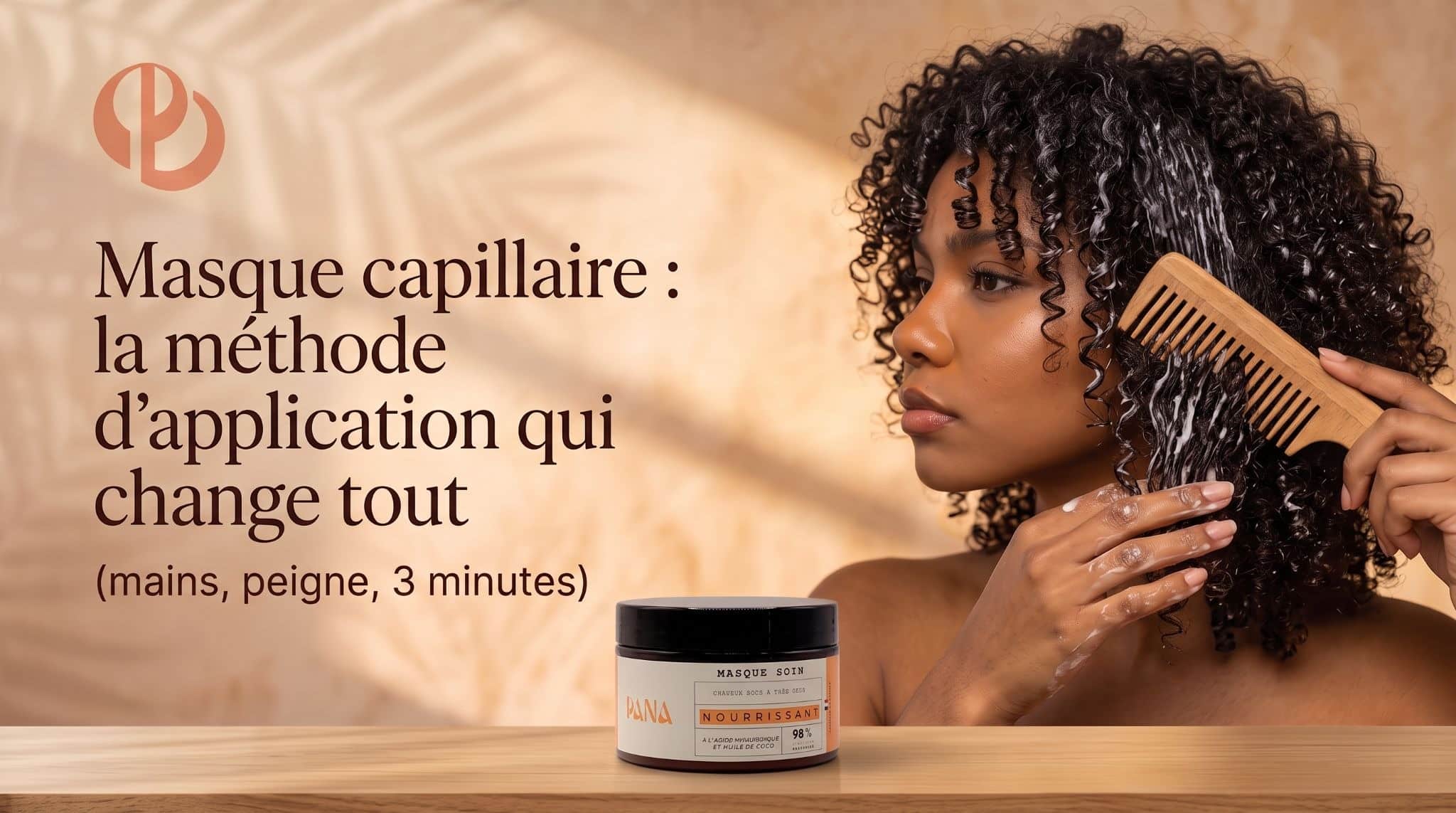
In two steps: first, with your hands, working the product in and distributing it evenly along the lengths of your hair with a light massage; then with a comb, running it through strand by strand to distribute the treatment to the very last fiber and seal the cuticles around it. The hands apply, the comb seals.
The detailed technique, as practiced in the baccalaureate exam:
- Squeeze out the excess water lightly After shampooing: hair should be damp, not dripping wet. Excess water would dilute the treatment.
- Dispense into the palms of your hands. and warm the product between your hands: it spreads better and penetrates more readily.
- Apply from mid-lengths to ends, by pressing the strands between the palms, then gently massage: the treatment penetrates the fiber instead of remaining on top.
- Focus on the tips, the oldest and most thirsty for hair.
- Comb, strand by strand, Using a wide-toothed comb, points upwards. This is the step that everyone skips and that changes everything; we will dedicate the following section to it.
- Leave on briefly, rinse thoroughly.
Applying a hair mask can be summed up in one formula: massage to work it in, comb to seal it in. Everything else, including the application time, follows from these two steps.

Why is it necessary to comb your mask?
Because the comb performs two functions that hands alone cannot: it distributes the treatment to each hair, reaching even the inner strands that palms never touch, and most importantly, it seals the hair cuticle around the treatment. The mask is no longer simply placed on the surface of the hair; it is sealed within it.
This is the application's best-kept secret, and the bed analogy makes it crystal clear: applying the mask to your hands is like putting on the blanket; combing it is like tucking in the bed. Without tucking it in, the blanket slips off at the first movement; tucked in, it stays in place all night.
Technically, the surface of the hair is made up of scales, arranged like roof tiles. Massaging the hair helps the treatment penetrate beneath these scales; combing, in the direction of the hair fiber, smooths them and folds them over. The result: the treatment is sealed inside and continues to work during application and after rinsing, instead of being washed down the drain.
Combing through your hair mask offers a third bonus: detangling. Hair saturated with conditioner glides through knots without breakage, and you step out of the shower already detangled. Three benefits, thirty seconds of effort: the best value for money in your entire routine.

How long should you leave a mask on for?
Two to three minutes is enough, provided the mask is applied, massaged, and combed through properly. If it's unevenly distributed or applied in clumps without a comb, it will take much longer for a lesser result. The application time never compensates for a sloppy application: it's the quality of the technique that makes the difference, not the timer.
This is the unexpected approach that surprises our clients the most, as they are used to the recommended twenty minutes in the instructions. The logic is quite simple: a treatment massaged into the hair fiber and sealed beneath the cuticles is already where it needs to work; leaving it on for hours adds nothing, it simply waits. Conversely, a treatment applied only to the surface, on strands stuck together in clumps, never reaches the interior: the twenty minutes are wasted.
The mask exposure time is therefore adjusted as follows:
- Application according to the rules (massaging + combing): Two to three minutes, the time it takes to soap yourself. That's the length of each wash.
- Very damaged hair, craving a pampering treatment: Five to ten minutes won't hurt, under a hat or a warm towel if you like. A comfort, not a necessity.
- Neglected application: No stopwatch will save the session. Pick up the comb, not the watch.
Can you apply a hair mask to dry hair?
For a classic moisturizing mask, no: it works best on washed and towel-dried hair, which is damp. The water present in the hair fiber facilitates the penetration of the treatment, and it's this moisture that the rest of the routine will seal in. On dry hair, the treatment doesn't penetrate well and is even harder to rinse out.
The question of whether to use a hair mask on dry or wet hair comes up constantly, and the answer lies in the product's purpose:
- The moisturizing mask It works with water: it provides it, helping the hair fiber retain it. Without initial moisture, it coats a sealed hair fiber. Always damp hair, and the leave-in conditioner will then seal in everything the water-mask duo has created.
- Rich pre-shampoo treatments, Oil baths, in particular, are applied to dry hair before washing: they're a different category, a different task, a different time. Don't confuse the two; their methods of application are completely different.
The infallible guideline: if the product is rinsed off, it is applied to damp hair after shampooing; if it precedes shampooing, dry hair is the place to start.
Why should you never apply the mask to the roots?
Because the roots don't need it and pay the price: the mask makes the scalp oily, weighs down the roots, and triggers rapid re-oiling. Remember this household rule: only shampoo goes to the roots; treatments and masks belong on the lengths and ends.
The logic is based on the relationship between different areas of the hair. The roots live close to the scalp, which produces its own natural oil, sebum, and expects only one thing from you: cleanliness. The lengths and ends, however, are far from this source and age by drying out: it is these parts that the mask is designed for.
A root mask compoundes the damage: the scalp suffocates under a rich layer it doesn't need, the hair becomes flat as soon as it dries, and oiliness increases rapidly. If your roots get oily quickly, first check where your mask stops: the mid-lengths are not a suitable place to apply it.
In practice, apply from the ear downwards: everything above belongs to the shampoo.
Mask before or after shampooing?
Then, as always, for a moisturizing mask: the shampoo cleanses the hair fiber and saturates it with water, the mask conditions this clean, damp area, and then the leave-in conditioner seals it in. Before shampooing, other products, such as oil baths and prep treatments, come into play, each with a different role.
The order is not a detail in the instructions, it is the condition for effectiveness: a mask applied to dirty hair treats the dirt; applied after washing, it treats the fiber. Its exact place in the chain, between the second shampoo and the leave-in conditioner, obeys the complete logic of layering described in the order of application of the products (#22+39), itself dictated by the founding principle, water before oil, at the heart of our method for hydrating your hair according to the rules of the art (Silo 3 – pillar page).
And if your hair is so dry that the weekly mask is no longer enough, it is not its position that needs to be changed, it is the overall plan: the complete action plan for dry hair (#40) covers the whole chain, including split end trimming.
Three minutes well spent are worth more than twenty minutes of idleness.

Let's recap the method: towel-dried damp hair, warm the mask between your palms, massage from mid-lengths to ends, comb through each section to work the treatment under the cuticles, leave on for two to three minutes, rinse with lukewarm water for a fresh finish. And two absolute rules: never apply to the roots, never before shampooing.
Your current masks deserve this second chance before you buy anything new. And if you want to see the combing technique in action, it's part of every shampoo ritual at [company name]. Pana Beauty : ask your hairdresser to show it to you, and leave with our moisturizing mask, formulated without silicone so that the treatment that enters the fiber is treatment, nothing else.